
The science behind ocean waves is more fascinating than most surfers realise.
Introduction
The science behind ocean waves is more fascinating than most surfers realise, and understanding it will make you a better, smarter surfer in the water.
Ocean waves are one of the most fascinating natural phenomena on Earth. While they may appear simple on the surface, their formation is the result of complex physical processes involving wind, energy transfer, and the movement of water particles.
Most ocean waves are generated by wind blowing across the sea surface, where friction causes energy to pass from the air into the water. As this energy builds up, it creates the waves that travel across vast distances of the ocean. Understanding how ocean waves form helps us better appreciate the dynamics of the marine environment and explains why waves vary in size, speed, and shape.
This scientific knowledge is essential not only for oceanographers but also for surfers, sailors, and anyone interested in the powerful forces that shape our oceans.
1 What is an Ocean Wave?
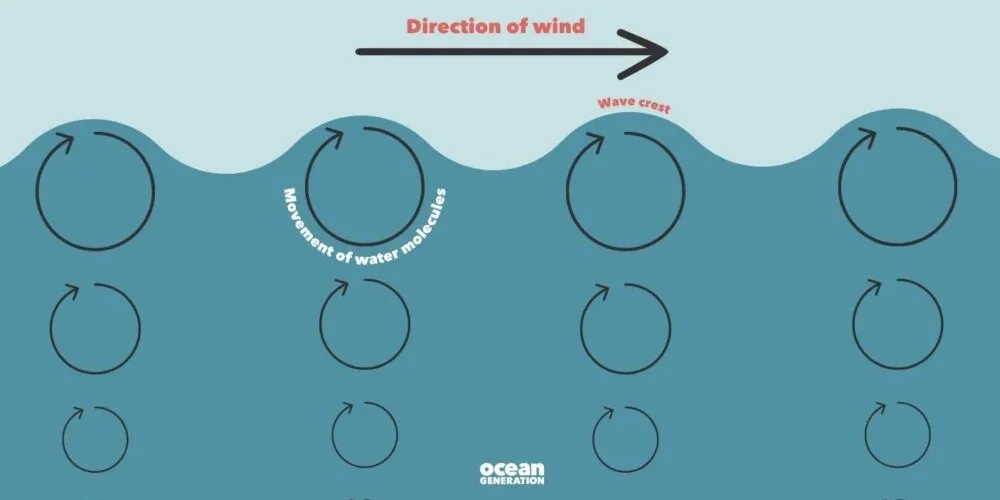
Ocean wave is a movement of energy across the surface of the sea, not a movement of water itself. As a wave travels, water particles move in circular motions, returning nearly to their original position once the wave passes. This is why waves can cross entire oceans without transporting large amounts of water.
When wind blows over the ocean, friction between the air and the water transfers energy to the surface, causing the water to rise and fall in a rhythmic pattern.
The stronger and longer the wind blows, and the greater the distance it travels (called a fetch), the larger the waves become.
2 The Role of Wind in Wave Formation
Wind is the primary force responsible for creating most ocean waves. When wind blows across the water surface, frication between the air and the sea transfers energy to the water.
Three main factors determine how large waves become.
♦Wind speed:
Stronger winds generate larger waves.
♦Wind duration:
The longer the wind blows, the more energy is transferred.
♦Fetch:
The distance over which the wind blows across the water.
When these three factors are significant, waves can grow in height and travel long destinations

→ If you want to know more about waves, join us from here
3 The Science Behind Ocean Waves: Energy Transfer and Wave Growth
From a physical perspective, ocean wave growth is governed by the transfer of kinetic energy from the atmosphere to the ocean surface.
This process begins with capillary waves, which are very small ripples controlled mainly by surface tension. These ripples increase the roughness of the sea surface, allowing the wind to apply greater force and transfer more energy. As wave size increases, gravity becomes the dominant restoring force, and the waves evolve into gravity waves.
The growth of these waves depends on the balance between energy input from the wind and energy dissipation caused by turbulence, internal friction, and waves breaking. When wind conditions remain stable over time and distance, waves can reach significant heights and longer wavelengths.
A simple way to understand this process is to imagine pushing a swing. A single push produces little motion, but repeated pushes at the right moment cause the swing to the rise higher. Similarly, continuous wind input causes waves to grow until equilibrium is reached.
Once waves leave the generation area, they form swells, which are characterized by regular spacing, smooth profiles, and long travel distances. Swells can transport energy across entire ocean basins with minimal loss.
🌊 Ready to experience the science in action?
Understanding waves is one thing — riding them is another. At Original Surf Morocco, our ISA-certified coaches teach you how to read, catch, and surf waves safely in Tamraght.
Join our 7-Night Beginner Surf Package — everything included, zero stress.

4 Ocean Wave Science: The Physics of Water Particles Motion
In wave dynamics, it is crucial to distinguish between the movement of energy and the movement of water particles. Although waves propagate horizontally across the ocean surface, individual water particles mainly move in closed orbital paths. In deep water, these paths are nearly circular, while in shallow water they become more elliptical.
The size of these orbital motions decreases rapidly with depth, a principle described by linear wave theory. At a depth approximately equal to half the wavelength, wave motion becomes negligible. This explains why deep sea environments remain largely unaffected by surface waves.
An everyday example is a floating buoy. As waves pass, the buoy moves up and down but does not travel forward with the wave. This demonstrates that waves transmit energy rather than mass, a fundamental concepts in ocean physics .
5 The Science Behind Ocean Waves: Why Waves Break Near the Shore
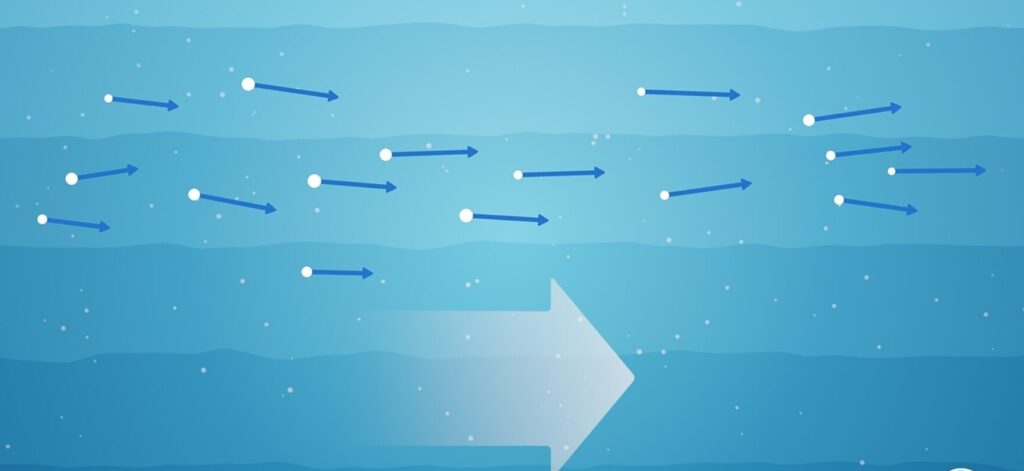
Wave breaking is a direct consequence of changes in water depth as waves approach the coastline. In deep water, wave speed depends mainly on wavelength. However, in shallow water, wave speed becomes controlled by depth. As the base of the wave interacts with the seabed, it slows down due to friction, while the upper part continues moving faster .
This difference in velocity causes the wave to steepen until it reaches a critical point where it becomes unstable and breaks. From a scientific standpoint, breaking occurs when the wave height exceeds a certain proportion of the water depth.
A useful analogy is traffic approaching a narrow road: cars at the front slow down while those behind continue at the higher speed, causing congestion and collapse. Similarly, waves compress and eventually collapse near the shore.
The type of breaking wave-spilling, plunging, or surging-depends on seabed slope and coastal morphology. These variations aren’t just fascinating to watch; they’re crucial in coastal engineering and beloved in surfing, where wave shape determines ride quality. Together, they reveal the science behind ocean waves, showing how the same forces that protect shorelines also create the thrill of catching the perfect break.

5-1 The Science Behind Ocean Waves: Types of Breaking Waves
⇒The Plunging Waves:
Occur when the wave crest curls forward and crashes down, violently, forming a hollow tube or barrel. This type of wave breaks suddenly and with great force, usually over steeps seabed. Plunging waves are common in surfing areas and can be dangerous for swimmers.
⇒The Spilling Waves:
Spilling waves break gradually as the crest slowly becomes unstable and “spills” down the front of the wave. The energy is released over a longer distance, making these waves less powerful than plunging waves. They usually form over gently sloping seabed and are safer for swimmers and beginner surfers. If you’d like to experience these waves, join us at “Original Surf Morocco” for a safe and fun surf adventure.
⇒The Surging Waves:
They occur when the wave does not fully break. Instead, it surges up the shoreline with little or no foam. These waves form over very steep beaches or rocky shores and reflect strongly off the shore, which can make them hazardous despite their lack of visible braking crest.
6 The Different Types of Ocean Waves
Not all waves are formed in the same way.
6-1 The Scientific Explanation of Ocean Waves: Important Types of Waves
♦Wind Waves
Wind waves are surface waves created directly by the action of wind blowing across the ocean or sea surface. Their size depends on wind speed, duration and the distance the wind travels over water. These waves are usually short, irregular, and change quickly.
♦Swell Waves:
Swells are well organized ocean waves that have travelled far from the area where they were originally generated by wind. Unlike wind waves, swells are smoother, more regular, and have longer wavelengths and periods. They can cross entire ocean basins with little loss of energy.
♦Tsunami waves:
Tsunamis are extremely long and powerful waves caused by sudden disturbances on the ocean floor such as underwater earthquakes, volcanic eruptions ,or landslides. In deep water, they are barely noticeable, but as they approach shallow coastal areas, they grow rapidly in height and become highly destructive.
♦Tidal Waves:
Tidal waves are long-period produced by the gravitational interaction between the earth, the moon and the sun. They cause the regular rise and fall of sea levels known as tides. Note the term “tidal wave” is often incorrectly used to refer to tsunamis, but scientifically they are different phenomena.
♦Internal waves:
They occur beneath the ocean surface, along the boundary between layers of water with different densities (caused by differences in temperature or salinity). Although invisible at the surface, they play an important role in ocean mixing and energy transfer.
7 Why Understanding Ocean Waves Matters for Surfers
Understanding the science behind ocean waves is especially valuable for surfers, as it directly influences wave selection, safety, and performance. By recognizing how wind, swell direction, tides, and seabed shape interact, surfers can better predict when and where waves will break.
Knowledge of wave generation helps surfers distinguish between short-period wind waves and long-period swells, which often produce cleaner, more powerful rides. Swells that have travelled long distances tend to organize into consistent sets, while locally generated wind waves are usually less predictable and more affected by surface conditions.
Wave particle motion also explains why wave energy changes as waves approach shallow water. As waves slow and steepen near the shore, understanding breaking mechanics allows surfers to anticipate where waves will peak and how they will break. This is particularly relevant at point breaks, reef breaks, and beach breaks, where seabed contours strongly influence wave shape.
Tidal influence plays an equally important role. Since water depth affects wave speed and breaking behaviour, knowing whether a spot works best on low, mid, or high tide can significantly improve both wave quality and safety.
In regions with consistent swell exposure and varied coastal geography, such as Morocco’s Atlantic coastline, applying basic wave science helps surfers make informed decisions, choose appropriate equipment, and better understand changing conditions in the ocean.
Conclusion
Ocean waves are the result of intricate interactions between wind, water, and energy. From their formation in the open sea to their dramatic breaking along coastlines, waves reflect the powerful physical forces at work in the ocean waves.
By understanding the science behind ocean waves, we gain deeper insight into marine dynamics and the natural processes that continuously shape our planet .
This knowledge not only enriches scientific understanding but also enhances our connection to the ocean, whether we observe it form the shore or interact with it through activities like sailing and surfing.
Now that you understand how ocean swells are formed, see how our local coaches use this science to get you on the right waves. Explore our Premium Beginner Surf Coaching Package
Or if you want to talk directly with our team: come surf with us
FAQ
How long can ocean waves travel?
Ocean waves, especially swells, can travel thousands of kilometres across the ocean with minimal energy loss. Swells generated by powerful storms can cross entire ocean basins before reaching distant coastlines.
Do ocean waves move water forward?
No, ocean waves mainly transfer energy, not water. Water particles move in circular or elliptical paths and return close to their original position once the wave passes.
Why are waves bigger in winter?
Waves are often larger in winter because storms are stronger and more frequent, generating powerful winds over long distances. This increases wave height, energy, and swell consistency.
What determines where waves break?
Waves break due to changes in water depth and seabed shape. As waves slow in shallow water, they steepen and collapse. Factors such as reef structure, sandbanks, and coastal slope determine how and where this happens.
Why do some waves peel while others close out?
Wave peeling is influenced by the angle of swell approach and seabed contours. Point breaks and angled sandbanks allow waves to break gradually, while straight shorelines often cause waves to break all at once.